How to Move to France from the UK
France is a beautiful country and has much to offer its new residents. However, you must know what you’re getting yourself into before moving to France from the UK. Researching the country will help you make an informed decision about where you want to live and what kind of lifestyle suits you best.
Before the big move, learn as much as possible, not only about the French culture and traditions but also about practical things, such as the French tax system, healthcare system, and current political situation.
Here at TRCI we are on hand to ensure your move to France from the UK is a success. For any advice on moving to France, please contact us.
Moving to France from UK Checklist
1. Calculate your budget
When relocating to another country, it’s essential to estimate the living expenses you’ll need to cover. This will help you avoid unpleasant surprises after arriving!
Before moving, research the cost of living in the city you’re relocating to and prepare a monthly budget for each of these categories:
Rent
Utilities, such as gas, electricity, phone and internet
Groceries
Transport
Eating out
Entertainment, such as going for a night out with friends or to the cinema on the weekend
Other activities that fit your lifestyle, such as the gym membership
2. Secure your French visa
Depending on how long you’re planning to stay in France – whether for 3 months or permanently – you’ll need the correct type of visa that applies to your situation. And depending on the type of visa you need to apply for, you’ll have to prepare different documents during your application process.
These are the different visa categories that you may fall under.
Work visas
Study visas
Family visas
Working holiday visas
Long-stay visas for religious purposes
Long-stay visas for other purposes
For help with applying for your French visa, contact us.
3. Organise your move
Organizing your move is the most exciting part of your journey, except for actually arriving in France. Relocating from one country to another always requires a lot of thought and preparation, so it’s best to break down the process into smaller steps.
At TRCI we handle all of this documentation and administration for you, check out our Private Relocations service.
4. Organise your paperwork
Preparing your documents may be a bit tedious, but it’s important that you have everything sorted out properly before your move.
First, make sure that all your documents are valid, such as your passport, driving license, and ID, are valid. Then, ensure you’ve sorted all the important documents, such as medical documents, education certificates, banking documents, etc.
5. Sell the stuff you don’t need
If you’re planning a big move, you’re likely eager to get rid of all the things you won’t take with you or that you don’t need anymore. You can sell them on internet marketplaces like eBay and put the money into your savings account.
6. Find a storage unit
This may be an excellent solution if you want to keep a few things but don’t have a secure place to store them while you’re away.
7. Plan the transportation
Depending on how many things you’re taking with you, you’ll need to choose the most suitable form of transportation from the UK to France.
If you’re moving with just a few suitcases, you can go by plane or train. But if you’re taking plenty of boxes, hiring a professional removal company may be the best option.
8. Sort your utilities
Before or immediately after arriving in France and settling into your new home, you’ll need to sort your utilities. If you’re renting an apartment, you may already have all the utilities, such as electricity, gas, and even internet, set up in the flat.
But in case you need to sort them out on your own, here’s a quick overview:
Electricity: Most French homes have electricity and gas supplied by EDF (Électricité de France). The good news is that you can set it up online, even before you move.
Internet connection, TV, and landline: If your new home doesn’t have a landline, TV, or internet connection, you’ll have to do it upon arrival. To set them up, you can go to Bouygues Telecom, SFR, or Orange – the three biggest internet providers in France.
9. Open a French bank account
Using your UK bank account in France may work for a while, but eventually, you’ll need to open a French account – especially if you’re planning to stay in France for more than 3 months.
Opening a bank account is simple with TRCI - even for non-residents. With online banking, we will open an account online, even before moving to the country. This way, if you need to sort your utilities or get a contract with an internet provider, you’ll be able to do that with a French bank account.
10. Apply for a residence permit
As we’ve already mentioned in this article, British citizens living in France for longer than 3 months are required to apply for a carte de séjour – a temporary residence permit.
Although you’ve got two months to do that after arriving in France, it’s advisable to do it as soon as possible. All you need to do is go to the nearest French prefecture and register for your permit!
Retiring to France from the UK
With the UK no longer being a part of the European Union, British pensioners looking to retire to France might be wondering if it’s still possible for them. It is! If you’re planning on relocating to France for your retirement after Brexit, you can still do it, but you’ll have to apply for the correct visa and meet specific requirements.
So, let’s go over what you need to know to retire to France from the UK.
Retirement visas
There is no specific visa for retirees who wish to move to France. While there is a residency card called “carte de séjour retraité”, it doesn’t apply to anyone wishing to retire to France.
So, you’ll need to go through the same process as everybody else who wants to relocate to France. Let’s break down the process into simple steps:
Pensions
As a retiree expat in France, you’ll still be able to receive your UK state pension. Moreover, your UK pension will still benefit from the uprating system, which means it’ll continue to rise proportionately to inflation and other factors.
You might also be able to transfer your UK private pension funds into the QROPS scheme (Qualifying Recognised Overseas Pension Scheme). However, if you’re thinking of doing that, you should keep up-to-date with the continuously changing laws after Brexit to see if it’s truly beneficial for you.
Healthcare
One of the requirements to apply for a long-stay visa to retire to France is proof of healthcare. To get your visa, you’ll need to provide proof of international health insurance with your application to get your visa.
This insurance needs to be valid for the entire duration of your stay in France (or the duration of your visa) and provide a minimum coverage of €30,000. It also needs to cover the costs of medical repatriation and hospital treatment.
Once you arrive in France, you can cancel your international health insurance and apply for the French one instead. If you receive a pension from the UK, you can still apply for the S1 form to cover healthcare costs in France.
Where to Live in France if You are English
If you’re a British citizen planning to move to France, you might be wondering where is the best place to live in France. You might be looking for an expat community and asking yourself where do most British expats live in France.
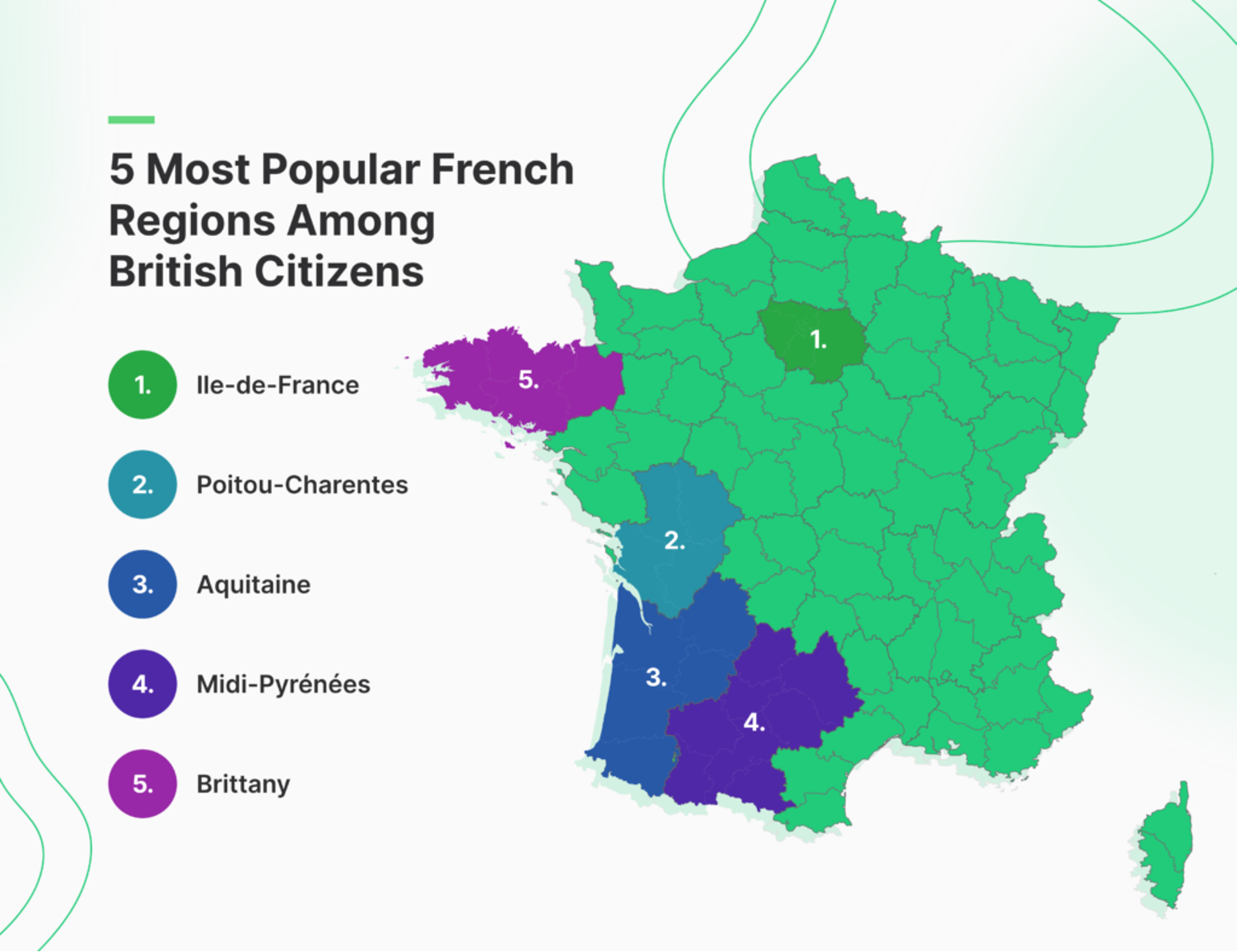
Here are the 5 most popular regions among British citizens who relocated to this beautiful country.
Ile-de-France
Ile-de-France is the most popular French region amongst expats in general. Given that Paris is the capital city of this region, this comes as no surprise! Paris has everything you can ask for: culture, history, business centres, nightlife, restaurants, etc.
And for those who want to escape the chaos of a big city, the smaller towns on the outskirts of Paris are an excellent place to find the balance between the suburb and city lives.
Poitou-Charentes
The French region of Poitou-Charente is a popular place for British expats. The area has a long history of welcoming British residents, with many choosing to move there permanently after spending time in the region on holiday.
Poitou-Charente is situated on the west coast of France and borders the Atlantic Ocean. The area has been inhabited since prehistoric times and has some of the oldest towns in France, such as Poitiers, La Rochelle, and Saintes.
Aquitaine
Aquitaine is one of France’s most popular regions for British expats. The Aquitaine region is located on the southwest coast of France and borders Spain. The area attracts many expats due to its mild Mediterranean climate and beautiful beaches.
The capital of Aquitaine and its biggest city is Bordeaux. Other major cities in the region include Bayonne and Biarritz – one of the favourite holiday towns of the French.
Midi-Pyrénées
The Midi-Pyrenees region, which is part of the Occitania region since 2016, is a large area in southwest France, popular with expats because of its proximity to Spain.
The region has a rich history and culture, with its capital city, Toulouse, home to beautiful architecture and some fantastic restaurants.
Brittany
Brittany is a region in the northwest of France and is one of the most popular regions for British expats. It’s renowned for its beautiful coastline, which has a few of France’s most beautiful beaches.
There are many reasons why Brittany is so popular with British expats: the climate is milder than other regions in France, there are excellent transport links to other parts of France and Europe, it has a thriving economy, and delicious regional cuisine.
Moving to France from the UK doesn’t need to be difficult
This wraps up our guide on moving to France from the UK. If you’re a British citizen considering relocating to France, our advice will hopefully prove helpful. Contact TRCI today to discuss your needs in more detail.